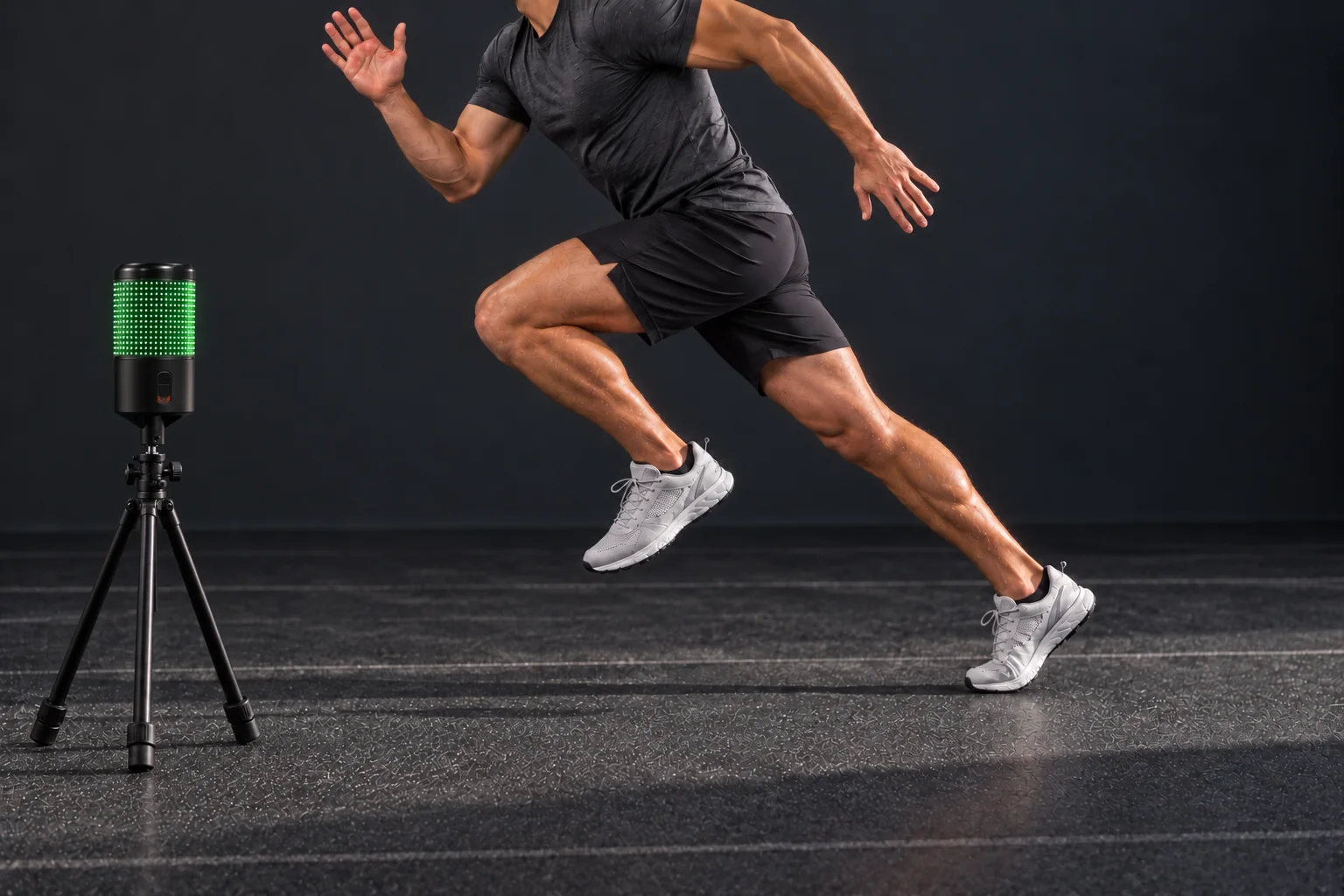
Get there first.
Every coach you've ever had told you to fix your first three steps. We're the first to show you exactly how.
Won in the first few steps.
Games aren't won at top speed. They're won getting there.
In seven Premier League seasons, sprints per player nearly doubled, and the average sprint got shorter: 5.9 metres, about the depth of the six-yard box.
It's still climbing. Over the next decade, team sprint distance rose another 40% while total distance barely moved. More bursts. Shorter bursts. More of them deciding the game.
A tenth of a second decides it.
In 45% of the goals of a full Bundesliga season, the scorer sprinted first.
Most sprints in a game last two to four seconds and cover less than 20 metres. In a third to two thirds of their matches, elite players never even reach 90% of their top speed. The race is decided early.
That's the loose puck. The 50/50 ball. The step that turns a chase into a breakaway.
Illustration using a standard sprint acceleration model. At 10 m, a tenth of a second works out to between half a metre and 0.8 m, depending on the athlete.
Speed is trainable.
Across 48 studies, sprint training cut 0 to 10 metre times by 3 to 5%.
On a 1.8 second start, that's up to nine hundredths of a second, or more than half a metre by the 10 metre mark.
The best accelerators don't push harder. They push in the right direction. The length and push of your first four steps predict how fast you get going, and strength adds to it: in the research, squat gains tracked sprint gains.
And what you build off the ice shows up on it. Off-ice sprint times and on-ice skating speed move together.
One summer. Faster starts.
Our acceleration test: a 10-yard sprint with a 5-yard flying start. Every valid trial on our timing gates, May against August.
10-yard time with a 5-yard flying start. Averages of every valid trial each month. Not every athlete was tested in both months.
Every rep, timed.
Athletes who see their sprint times after every rep improve more. Here, you always will.
Source 12Timing gates
VALD SmartSpeed. Every start timed to the hundredth, so you know which cue worked.
Force plates
Hawkin Dynamics. How much force you make, how fast, and which leg makes it.
Smart insoles
Plantiga. How each step of your acceleration is built.
Your coach
Twenty-five years of knowing what to do with all of it.
Still growing?
Before the growth spurt, sprint training shows little reliable effect. After it, the effect is large. If you haven't hit yours yet, keep building. We track your speed so you'll know when it's coming, and be ready when it does.
Source 13Take the tenth back.
Book an assessment. We'll time your first steps, find where the time goes, and build the plan to get it back.
Sources
- Barnes et al. 2014, The evolution of physical and technical performance in the English Premier League
- Allen et al. 2025, Physical trends in the Premier League, 2015/16 to 2024/25
- Faude et al. 2012, Straight sprinting is the most frequent action in goal situations
- Haugen et al., The role and development of sprinting speed in soccer
- Di Salvo et al. 2010, Sprinting analysis of elite soccer players
- Buchheit et al., How often players reach peak speed in matches
- Rumpf et al. 2016, Effect of sprint training methods over various distances
- Morin et al. 2011, Technical ability of force application as a determinant of sprint performance
- Murata et al. 2018, Step characteristics and acceleration in soccer players
- Seitz et al. 2014, Increases in strength and sprint performance
- Farlinger et al. 2007, Off-ice tests and on-ice skating performance
- Weakley et al. 2019, Feedback and sprint, jump and strength adaptations
- Moran et al. 2017, Maturation and sprint training in youth